
Malayalam Words for Kids — Animals, Fruits & Everyday Objects
Quick answer: To teach young children basic Malayalam words for kids, start with visible everyday items: animals like Aana (elephant), Poocha (cat), Patti (dog); fruits like Maanga (mango), Chakkapazham (jackfruit), Vazhapazham (banana); and household objects like Kasera (chair), Mesha (table) and Kuda (umbrella). Use pictures, songs (tharattu), play and sticky labels around the house. Focus on pronunciation (watch the tricky “zh” sound), repetition and context — this helps children connect words to the world and culture of Kerala.
Short hook: Simple, daily words tied to animals, fruits and objects are the fastest way to gift a child their Malayalam vocabulary — practical, fun and deeply cultural.
Introduction: The Sweetness of the Mother Tongue
Hearing a child speak their first Malayalam words is a special kind of joy. Whether you live in Thiruvananthapuram, Dubai or New Jersey, giving a child Malayalam connects them to family, festivals and a living culture. Malayalam is phonetic — we say what we write — so spoken practice and repetition are your best tools. Start with tangible items the child sees every day: animals, fruits and familiar objects. These anchor words will open doors to stories, songs and deeper learning.
Why Start with Animals and Nature?
Animals are universal and exciting for children. A dog barks and a cat meows everywhere, but teaching the local word (like Poocha for cat) gives children cultural context. Kerala’s stories and festivals are full of animals — elephants at temple processions, birds on the backwaters — so animal words tie vocabulary to place and tradition.
Young learners also enjoy sound imitation, which makes animal names easy to remember: a dog is Bow-Bow and a cat is Myaoo in Malayalam play language.
The Big Three: Elephant, Cat, and Dog
If you teach only three words this week, let them be these culturally important and easy-to-use words.
Aana (Elephant)
Pronunciation: Aa-na
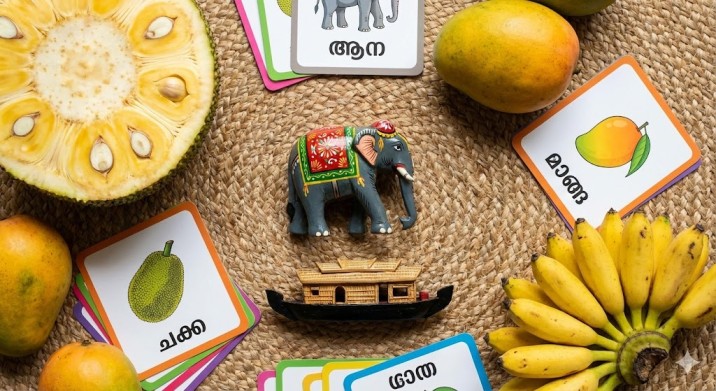
Elephants are cultural icons in Kerala — part of festivals and temple life. The word Aana is simple and meaningful for kids; point to pictures and describe tuskers at processions.
Poocha (Cat)
Pronunciation: Poo-cha
Cats are common household companions. The soft sounds in Poocha are easy for toddlers to imitate. Nursery rhymes about cats are widely used in Malayalam homes.
Patti (Dog)
Pronunciation: Pat-ti
While some regions also say Naaya, Patti is a child-friendly, quick word that works well in games and story time.
List of Common Animals in Malayalam
Below are handy animal words to expand your child’s vocabulary. Use picture cards and mimic sounds for memory.
- Simham — Lion. Sim-ham
- Kaduva — Tiger. Ka-du-va
- Muyal — Rabbit. Mu-yal
- Meen — Fish. Meen
- Kakka — Crow. Kaak-ka
- Pasu — Cow. Pa-su
- Pakshi — Bird. Pak-shi
- Otta (Aadu) — Goat. Aa-du
Tip: Turn the list into a matching game — show pictures and ask “Ithu entha?” (What is this?) to encourage recall.
Fruits of Kerala: Sweetness in Every Bite
Food is central to Kerala life. Fruit words are colorful and sensory — perfect for children.
Maanga (Mango)
Pronunciation: Maan-ga
Mangoes are often a child’s first tropical memory. Use taste and texture to reinforce the word.
Chakka / Chakkapazham (Jackfruit)
Pronunciation: Chak-ka / Chak-ka-paz-ham
Jackfruit is large and memorable; kids enjoy touching the spikes and tasting the sweet bulbs.
Vazhapazham (Banana)
Pronunciation: Va-zha-pa-zham (contains the “zh” sound)
The “zh” is a characteristic sound in Malayalam; if a child struggles with it, start with Pazham and refine over time.
Thenga (Coconut)
Pronunciation: Then-ga
Coconut features in many Kerala dishes and crafts — a great word for early learners.
Household Objects: Naming the World Around You
Objects inside the home are the best daily teaching tools because children see and use them every day.
- Kasera — Chair. Ka-se-ra (from Portuguese ‘cadeira’).
- Mesha — Table. May-sha
- Kuda — Umbrella. Ku-da
- Mittayi — Candy / Sweet. Mit-ta-yi
- Bomma — Doll / Toy. Bom-ma
- Pusthakam — Book. Pus-tha-kam
- Veedu — House. Vee-du
- Panthu — Ball. Pan-thu
- Vandi — Vehicle / Car. Van-di
Activity idea: Label these objects with sticky notes (Malayalam script or transliteration) so the child sees the word daily.
Table: Quick Reference Guide for Parents
| Category | English | Malayalam | Pronunciation |
|---|---|---|---|
| Animals | Cat | Poocha | Poo-cha |
| Animals | Dog | Patti | Pat-ti |
| Animals | Elephant | Aana | Aa-na |
| Fruits | Mango | Maanga | Maan-ga |
| Fruits | Banana | Vazhapazham | Va-zha-pa-zham |
| Objects | Chair | Kasera | Ka-se-ra |
| Objects | Table | Mesha | May-sha |
| Objects | Umbrella | Kuda | Ku-da |
| Food | Rice (cooked) | Choru | Cho-ru |
| Drink | Water | Vellam | Vel-lam |
Cultural Context: Nursery Rhymes and Bedtime Stories
Vocabulary sticks when it’s sung. Use Tharattu Pattu (lullabies) and simple rhymes to teach sounds and rhythm. Songs like “Kakkakuyile…” are staples in many homes. During festivals like Onam, use stories about Mahabali, the flower carpets (Pookkalam) and the Sadhya feast to teach related words.
Singing helps the child internalize pronunciation and cadence without conscious grammar study.
Tips for Teaching Malayalam to Non-Native Kids
- One Parent, One Language (OPOL): If possible, have one parent consistently speak Malayalam so the child learns contextually.
- Label the House: Stick notes on mirror (Kannadi), door (Vathil) and window (Janala).
- Play & Repeat: Use toys, picture cards and repetition — short, frequent sessions work best.
- Don’t Stress the “Zh”: The retroflex “zh” sound is tricky; allow approximations early on and correct gently.
- Use Cartoons & Songs: Malayalam kids’ channels and songs are great for exposure and entertainment.
Encouragement beats correction. Celebrate attempts and make learning part of playtime.
Ten Frequently Asked Questions
1. What is the easiest Malayalam word for a baby to say?
Amma (mother) and Appa / Achan (father) are common first words, followed by simple nouns like Poocha (cat) and Paal (milk).
2. How do I say “I love you” to my child in Malayalam?
You can say Ammaikku/Achanu ninne orupadu ishtamanu (Mom/Dad loves you a lot), or use endearments like Karale (my heart) or Muthe (my pearl).
3. Is Malayalam difficult for English-speaking kids?
Grammar differs (SOV order), but individual nouns are straightforward. Pronunciation of certain sounds takes practice; early exposure through play helps a lot.
4. What is the Malayalam word for school?
Commonly used words are Pallikoodam or Vidhyalayam, though “school” (English) is frequently used too.
5. How do you say “Water” in Malayalam?
Vellam — an essential survival word. Practice frequently with drinking activities.
6. What are some funny words that kids love?
Chakka (jackfruit) and Thavala (frog) are playful words that children enjoy saying and hearing.
7. How do I teach colors in Malayalam?
Start with basic colors: Chuvappu (red), Pacha (green), Manja (yellow), Neela (blue). Use colored toys and objects to reinforce.
8. What is the word for “Sleep”?
Urakkam is sleep. You can tell your child “Poi urangu” (Go and sleep) at bedtime.
9. Are there different dialects of Malayalam?
Yes, regional dialects exist (Kasaragod, Thrissur, Thiruvananthapuram etc.) but the basic words for animals, fruits and household objects are widely understood.
10. How do I encourage my child to speak back?
Ask simple questions: instead of stating “This is a cat,” ask “Ithu entha?” (What is this?). Pause and wait — children need time to retrieve words.
Conclusion
Teaching Malayalam words for kids is a joyful, gradual process. Start with animals, fruits and household objects, sing nursery rhymes, label the environment and keep lessons short and playful. Every new word is a bridge to family, festivals and culture. Whether you are in Kerala or abroad, these words give children a living link to their heritage.
Explore more kid-friendly Malayalam resources on Decode Malayalam — printable flashcards, audio pronunciations and song playlists to make learning fun and natural.
This guide is for educational and cultural purposes. Adjust activities to your child’s pace and consult children’s language resources for structured learning plans.